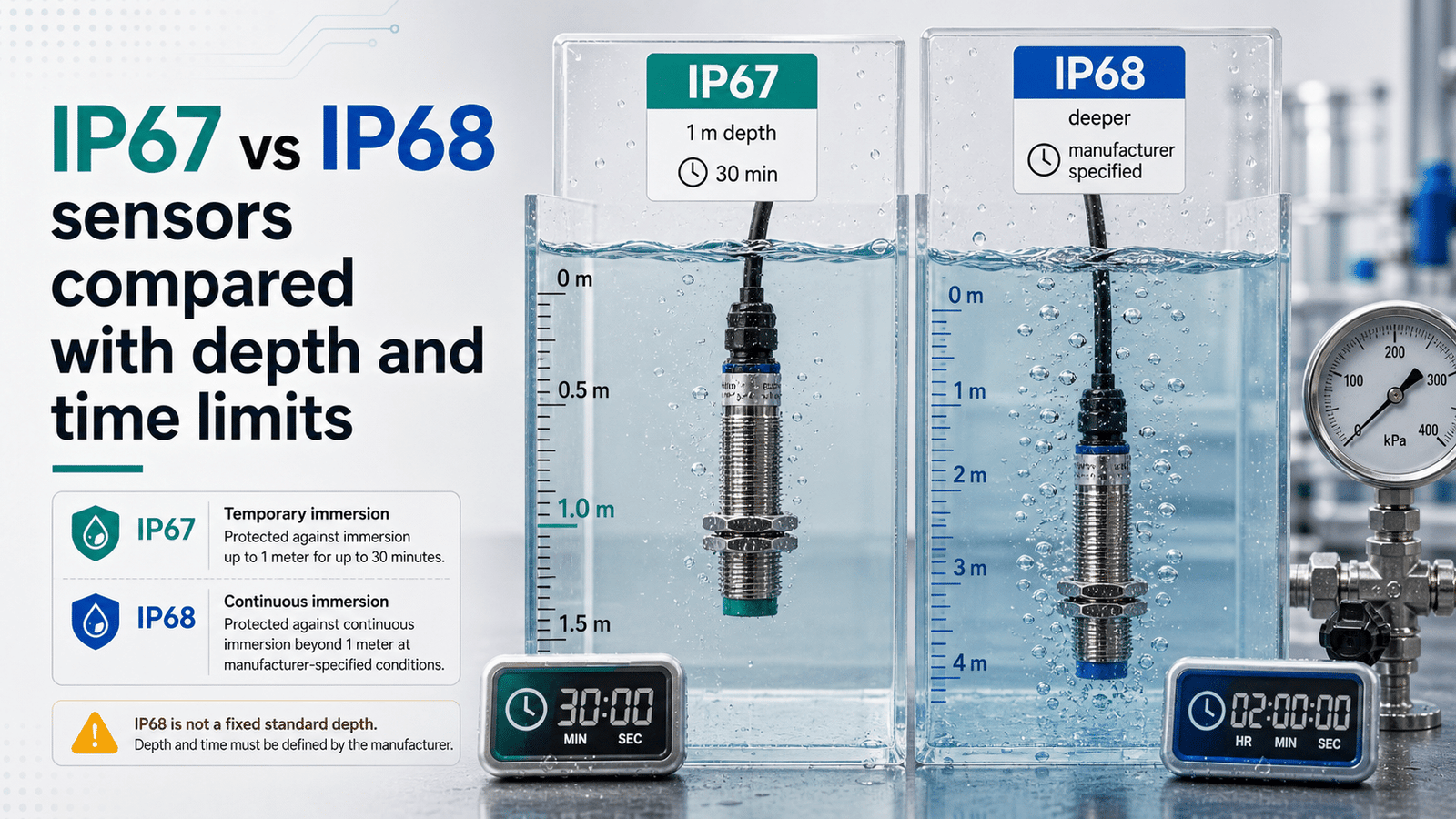
The key difference in an IP67 vs IP68 sensor comparison is water depth and submersion time, not dust protection—both are fully dust-tight thanks to the shared “6” rating under IEC 60529. An IP67 sensor withstands submersion at 1 meter for 30 minutes, a fixed standard limit. An IP68 sensor handles greater depths for longer periods, typically 1.5–3 meters, but the exact limits are set by each manufacturer, so always check the datasheet.
An IP67 vs IP68 sensor comparison really comes down to a single point: an IP67 sensor can survive 1 meter of water for 30 minutes, while an IP68 sensor is built to handle greater depths for longer stretches, though only up to the limits that the manufacturer decides to set. This guide walks through what each rating actually protects against, how deep and how long each one can go, how they’re tested, and which one you should pick for your own project.
Quick Takeaways
- Both IP67 and IP68 sensors are fully dust-tight; only water protection differs.
- IP67 guarantees 1-meter submersion for 30 minutes under IEC 60529.
- IP68 depth and time vary by manufacturer—always verify the datasheet.
- IP68 typically handles 1.5–3 meters, but exact limits differ per device.
- Neither rating protects against high-pressure jets; use IPx9K for that.
What’s the difference between IP67 and IP68 sensors?
The main thing separating these two comes down to water depth and how long the device stays under, not dust. Both ratings are completely sealed against dust, which is what that “6” digit stands for. An IP67 sensor can survive being underwater at 1 meter for 30 minutes, while an IP68 sensor handles deeper and longer time under water, with the limits set by whoever makes it, per IEC 60529 test conditions. So IP68 does better underwater, but only as far as its own spec sheet actually promises.
This is where people tend to get confused, because IP67 is a fixed number, 1 meter, 30 minutes, and that’s it, while IP68 keeps shifting around. The 8 only guarantees the sensor beats IP67. The real depth, whether that’s 1.5 m or 5 m, plus how long it lasts, lives in the datasheet rather than the rating itself. Two IP68 sensors can wear the same label and still have wildly different real limits, so you always want to read the fine print.
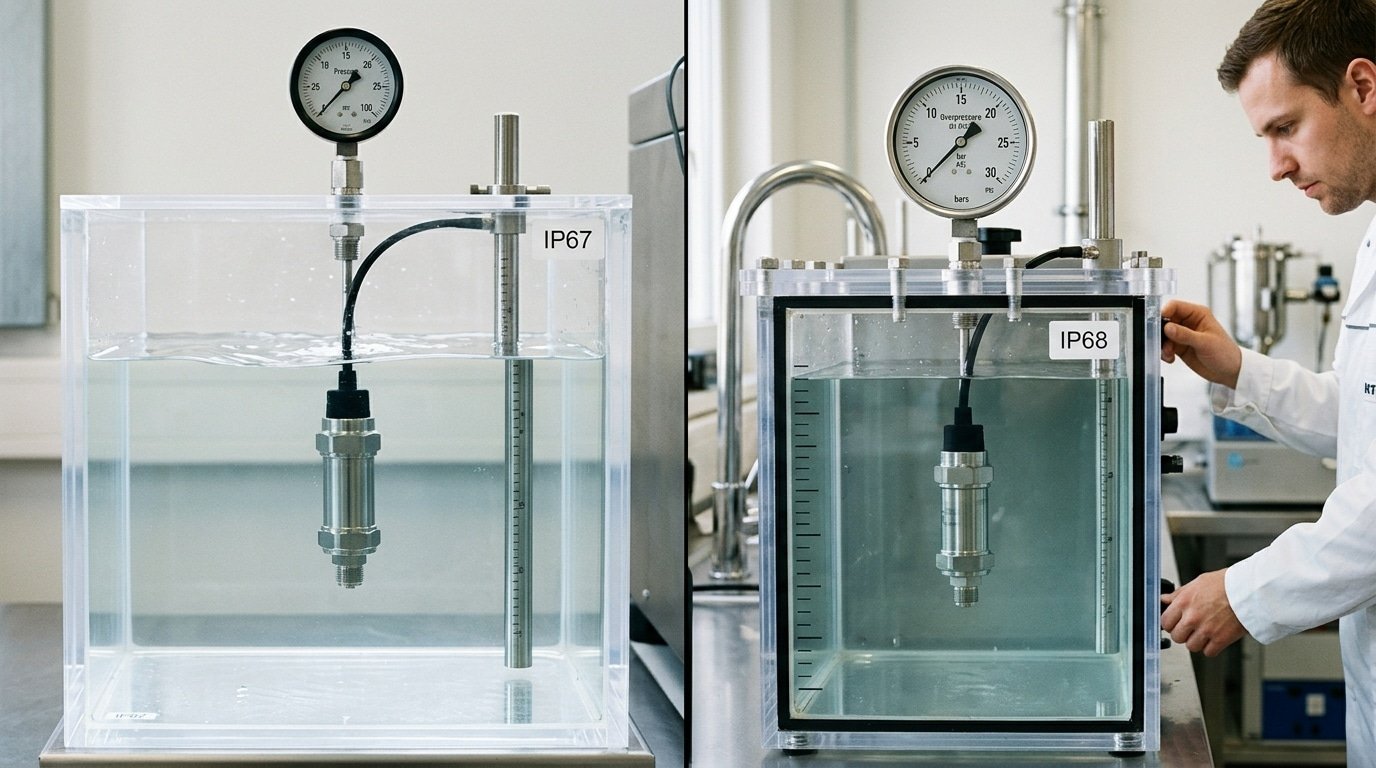
The immersion test relies on pressure. IP67 applies roughly 100 mbar of extra pressure, which matches about 1 meter of water sitting above it. IP68 asks for higher pressure, and the exact figure gets fixed for each individual device.
| Digit | Protects against | IP67 | IP68 |
|---|---|---|---|
| First (6) | Solid particles / dust | Dust-tight, zero ingress | Dust-tight, zero ingress |
| Second (7 or 8) | Water immersion | 1 m, 30 min[1] | >1 m, manufacturer-defined time |
Here’s a practical tip. You should never assume that “IP68 = ocean-proof.” A wall-mounted proximity sensor rated IP68 for staying under water at 2 meters can still fail once you drop it down to 10 meters. Match the number to the actual environment you’re dealing with.
What do the digits in IP67 and IP68 actually mean for a sensor?
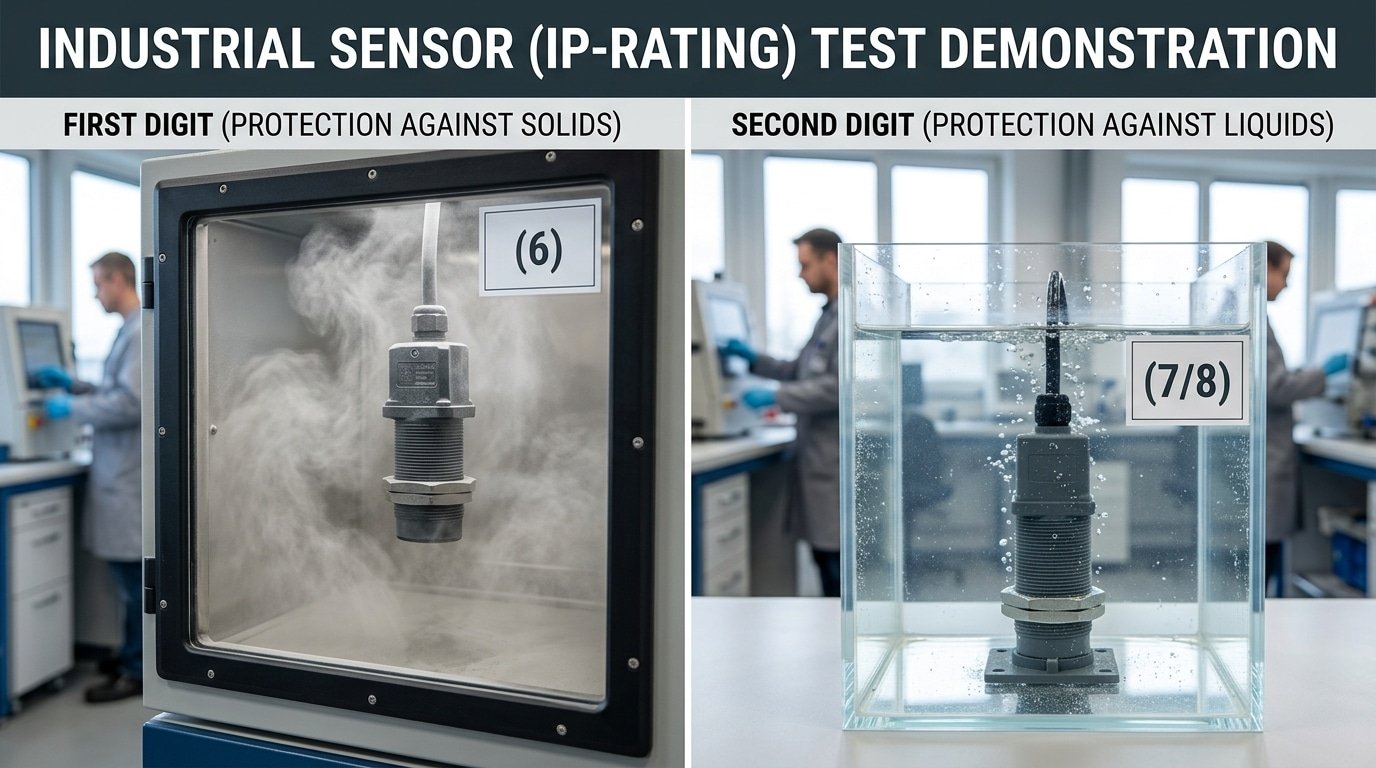
The two digits in an IP code split the job in two: the first digit rates solid protection, the second rates water. For both IP67 and IP68 sensors, the first digit is 6, meaning fully dust-tight, with zero dust ingress allowed under IEC 60529 test conditions. So dust is never what separates the two. Only the second digit, 7 versus 8, changes the water story.
IP stands for Ingress Protection, a standard published by the International Electrotechnical Commission (IEC). You can read the full framework in the IP code specification.
What does the first digit “6” physically test?
The “6” means the housing survives a dust chamber test. Engineers place the sensor in a sealed box filled with talcum powder, then pull a vacuum inside the housing for up to 8 hours. To pass, no dust may reach the internal circuitry. Because both IP67 and IP68 sensors share this identical “6”, dust resistance is a tie, you gain nothing by picking one over the other for dirty air alone.
What does the second digit “7” versus “8” test?
The “7” test submerges the sensor in 1 meter of water for 30 minutes and checks for harmful ingress. The “8” test goes further: continuous immersion below 1 meter, for a depth and time the manufacturer defines. That single digit is the entire IP67 vs IP68 sensor decision.
How deep and how long can IP67 vs IP68 sensors really survive underwater?
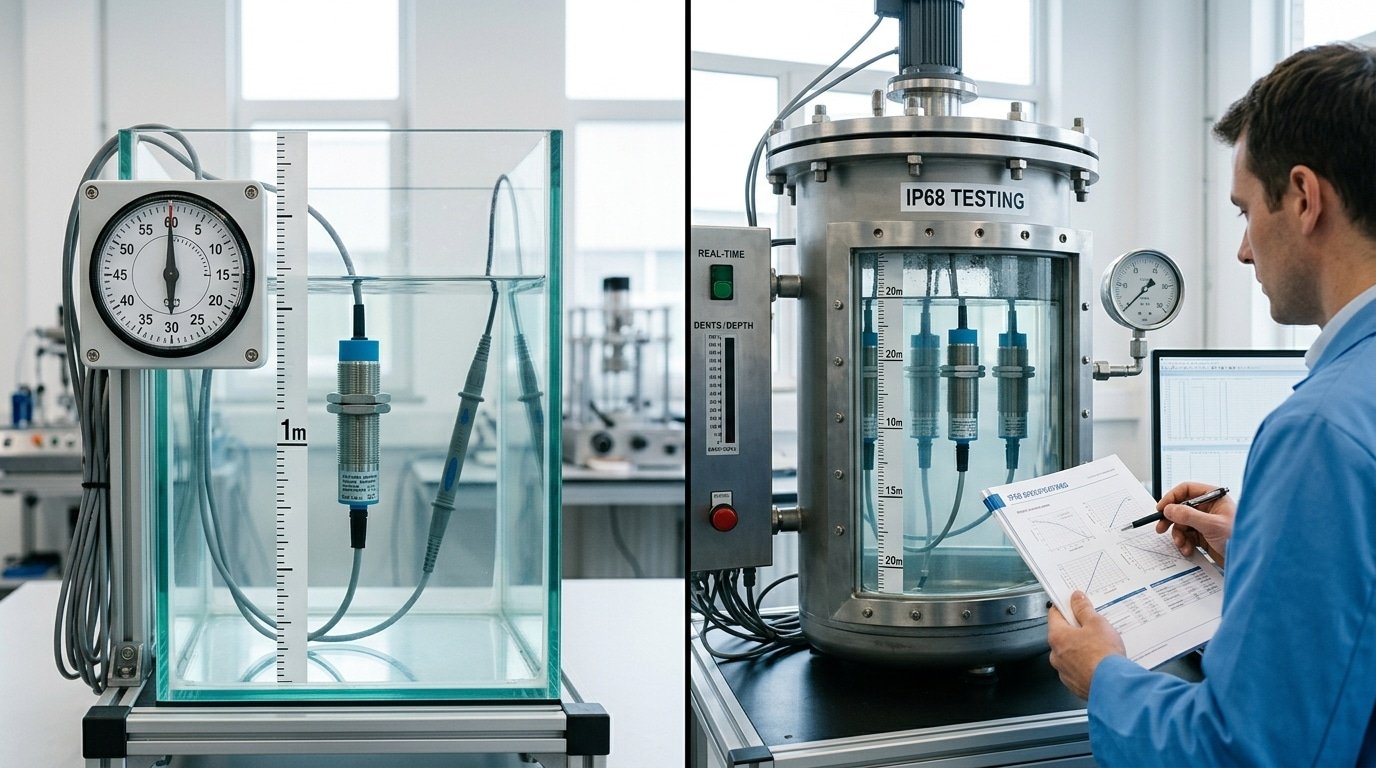
IP67 sensors survive exactly 1 meter of water for 30 minutes, a fixed limit written into IEC 60529 (2025). IP68 has no universal number. The manufacturer sets the depth and time, and real ratings range from 1.5 meters to over 20 meters. So never assume an IP68 depth, read the datasheet.
This is the trap that catches most buyers. The “7” in IP67 is a hard test: 1 meter, 30 minutes, no more. The “8” in IP68 only promises better than IP67, nothing else. One IP68 sensor might handle 1.5 meters, another 20 meters, and both wear the same label.
Why does the IP68 depth rating vary so much between sensors?
Because the standard lets each maker define the test. A pressure sensor guide notes IP68 units can be submerged continuously from 1 meter to several meters depending on the design (2025). Depth is set by the housing seal, cable gland, and internal pressure balance, not by the digit.
What does the depth number actually test?
Water pressure, measured as overpressure. The IP67 immersion test uses roughly 100 mbar, equal to about 1 meter of water. IP68 requires a higher figure, listed per device. When you compare an IP67 vs IP68 sensor spec sheet, look for the exact meter value and the tested duration, often printed as “IP68 (2m, 60min[2])”. No numbers means no real guarantee.
Why isn’t IP68 always the better choice for sensors?
An IP68 sensor is not always the smarter pick, mainly because it adds cost, size, and longer wait times for a level of water protection that most settings will never actually need. Since both IP67 and IP68 sensors are fully dust-tight (rated “6”) under the IEC 60529 standard, a dry factory floor really gains nothing from paying for the ability to sit underwater continuously.
That extra sealing shows up in the physical build itself. IP68 sensors often rely on larger connectors filled with a protective compound, where the wire entry is completely packed with resin to keep water out. All of that filling adds bulk, so the housing has to grow to make room for it, and in tight machine slots or on robot arms those few extra millimeters can force you into a redesign.
When does buying IP68 waste your budget?
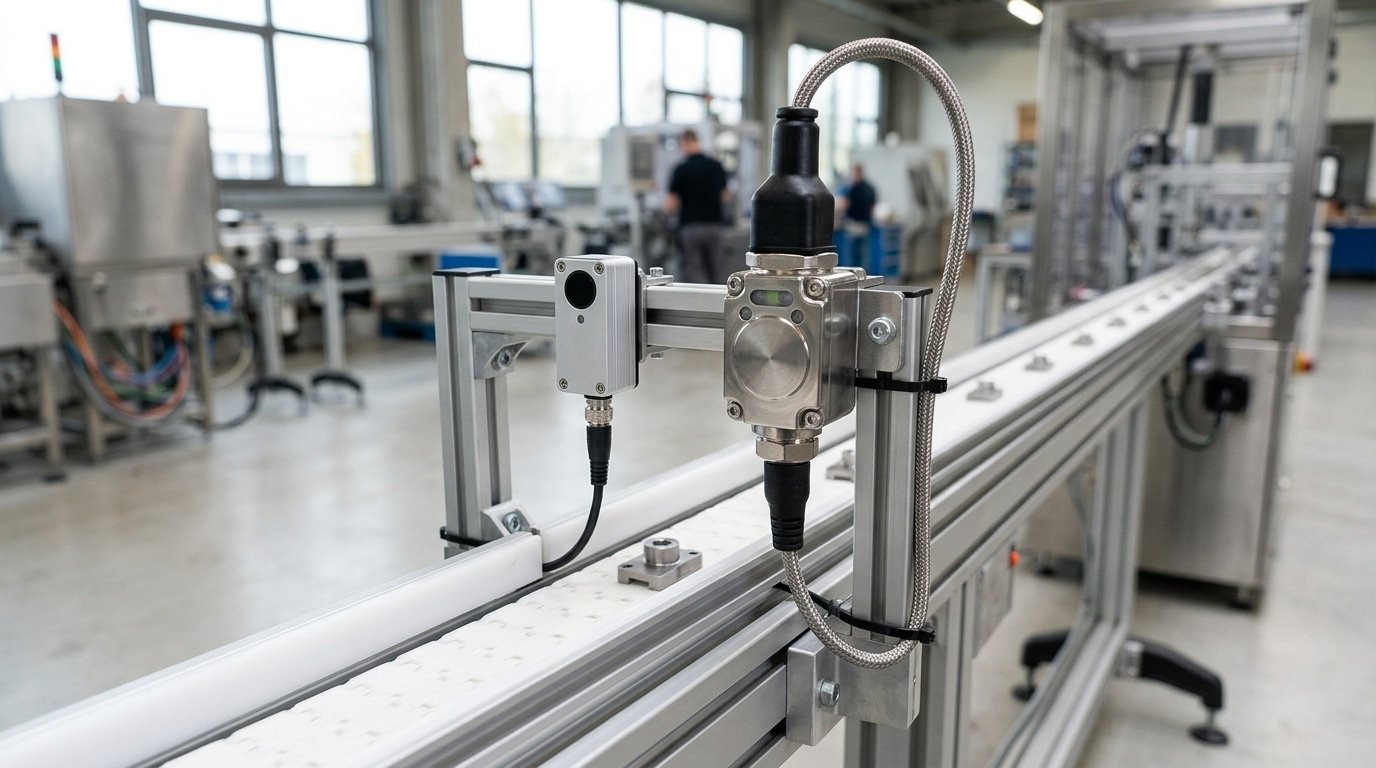
You can generally skip IP68 anywhere that being submerged is basically impossible. A sensor mounted on a conveyor 1.5 meters above the floor is going to see splashes and dust, not a swimming pool. IP67 handles that situation well, and in this IP67 vs IP68 sensor decision, over-specifying quietly drains money in three separate ways:
- Unit cost: IP68 sealing and the pressure testing that goes with it push up the price per unit, and that difference often becomes noticeable across a 500-unit order.
- Lead time: Depth testing specified by the manufacturer, following Machine Design’s sensor guidance, adds extra validation steps and stretches out delivery.
- Serviceability: Connectors that are completely filled with resin resist any repair out in the field, so a damaged cable really means replacing the whole unit.
There is one question worth asking before you order anything: will this sensor ever sit underwater? If the honest answer is no, then IP67 protects it just fine and keeps your list of parts and materials lean.
Why don’t IP67 and IP68 protect against pressure washing or steam?
Neither rating covers pressure washing or steam because IP67 and IP68 only test still water. An IP67 sensor is tested by dunking it in 1 meter of water for 30 minutes, per IEC 60529, no jets, no heat. For washdown lines you need IP69K instead, a separate test built for high-pressure, high-temperature spray.
⚠️ Common mistake: Assuming an IP68 sensor rated for 3-meter submersion will survive a high-pressure washdown. This happens because submersion ratings test static water depth, not pressurized jets—a power washer can breach an IP68 seal in seconds. The fix: for jet or steam cleaning, specify IPx9K testing, which validates 80°C water at 80–100 bar[3] from close range.
What does a pressure washer do that immersion never tests?
A food-plant washdown nozzle blasts water at 80,100 bar and 80°C[4]. Static immersion in the IP68 test peaks near 100 mbar of overpressure, roughly 800 times weaker. That hot, fast jet drives water past seals that easily survive a quiet dunk. IP69K reproduces the real threat: a spray gun at 80,100 bar, held 10,15 cm[5] away at four angles, with 80°C water. That’s why dairy and meat plants specify IP69K, not IP68.
Why is chemical resistance a completely separate spec?
IP codes ignore chemicals entirely. A sensor can hold IP68 and still fail after caustic cleaner attacks its seal, because the IP water and dust tests say nothing about the materials that contact it:
- Seal material: Nitrile (NBR) swells in strong bleach; FKM (Viton) resists it. IP tests neither.
- Cable jacket: PVC cracks under peracetic acid sanitizer; PUR and TPE hold up far longer.
Check the datasheet’s chemical compatibility table separately. Skip that step, and a fully rated sensor still leaks within months. IP tells you about water and dust, nothing about the cleaner spraying it every shift.
Which IP rating should you choose for your sensor environment?
Pick the lowest rating that reliably covers your worst-case exposure. For occasional splash, humid air, or dust, IP67 handles it, both IP67 and IP68 are rated “6” for solids, meaning completely dust-tight under IEC 60529 (2025). Only reach for IP68 when the sensor sits underwater continuously or past 1 meter deep.
Match the real condition to the rating, not the marketing tier: a worst-case event that lasts seconds is different from one that lasts all shift.
| Exposure condition | Minimum sufficient rating |
|---|---|
| Occasional splash or spray | IP66 |
| Humid indoor air, condensation | IP67 |
| Temporary flooding (up to 1 m, under 30 min[6]) | IP67 |
| Dusty factory floor, no water | IP6X (IP67 or IP68) |
| Continuous submersion, fixed depth | IP68 (spec the depth) |
Here’s the field trap: IP68 depth isn’t universal. It only means “better than IP67” at whatever depth the maker prints. So for the IP67 vs IP68 sensor call, always demand the exact tested depth and duration in meters and hours, not just the “8.” A sensor rated IP68 at 1.5 m for 30 minutes will drown in a 3-meter sump.
Dusty environments almost never need IP68. The dust digit is already maxed at both ratings, so paying for IP68 buys you water protection you may never use.
How long does an IP67 or IP68 rating actually last in the field?
An IP67 or IP68 rating is a factory test result, not a lifetime warranty. In the field, that rating typically degrades within 3 to 7 years as gaskets harden and adhesives fatigue. Both ratings start dust-tight at level 6 under the IEC 60529 standard, but heat cycling slowly opens the seal that keeps water out.
The main enemy is thermal cycling. Every heat-up and cool-down makes the enclosure expand and shrink, and over thousands of cycles this compression set flattens the rubber gasket so it no longer springs back. A seal that started at approximately 90% recovery can drop below approximately 50%[7], leaving a gap thinner than a hair, enough for moisture to creep in.
How do you verify an IP rating still holds in the field?
Test with a portable air-pressure decay tester, not water. You pressurize the sealed enclosure to a set level and watch for pressure drop over 30 seconds. A stable reading means the seal is intact; a slow leak flags a compromised gasket before water ever gets in.
What are the warning signs of a failing seal?
- Condensation inside the lens or window: fog that clears slowly means the gasket already leaks.
- Chalky or cracked gasket surface: hardened rubber loses its squeeze.
- Corrosion at connector pins: green residue signals trapped moisture.
For any IP67 vs IP68 sensor in high-temperature or washdown zones, plan a reseal check every 24 months. Replacing a $3 O-ring beats replacing a $200[8] sensor.
Real failure scenarios where the wrong IP rating cost time and money
The wrong IP rating fails in two directions: under-spec sensors flood and die, over-spec sensors burn budget for protection nobody uses. Since an IP67 sensor only survives 1 meter for 30 minutes, any deeper or longer exposure kills it. Three real-world patterns show exactly where teams lose money.
Case 1: IP67 proximity sensor drowned in a flooded pit
A pump-station operator mounted an IP67 proximity sensor low in a collection pit. During a storm, the pit backed up and held water at 2 meters for hours. The IP67 rating tops out at 1 meter for 30 minutes, so water forced past the seal within an hour. The failed sensor triggered a false pump signal and one day of unplanned downtime. Lesson: match the rating to the worst-case flood level, not the normal level.
Case 2: IP68 sensor wasting money on a dry conveyor
A packaging line spec’d IP68 sensors on a dry, dust-only conveyor. Each unit cost roughly 40% more than the IP67 equivalent and added weeks of lead time. The extra water rating did nothing here, dust protection is identical at IP6X for both. On 60 sensors, that over-spec burned thousands of dollars with zero benefit.
Case 3: Washdown line where both IP67 and IP68 failed
A food plant used high-pressure hot-water washdown. Both an IP67 vs IP68 sensor choice missed the point: neither covers pressurized jets or steam. Only IP69K handles that. Seals cracked in weeks. Lesson: identify the exposure type first, then the depth.
Frequently asked questions about IP67 vs IP68 sensors
The most-searched questions about the IP67 vs IP68 sensor choice come down to four practical worries: permanence, outdoor use, saltwater, and food processing. Both ratings share a “6” first digit, meaning they’re completely dust-tight under IEC 60529 test conditions. The differences below are all about water.
Is an IP68 sensor waterproof forever?
No. IP68 means continuous immersion beyond 1 meter, but only at the depth and time the manufacturer prints on the datasheet. A sensor rated “IP68 to 3 m for 24 hours[9]” isn’t rated for 5 m or for a week. Seals age, so treat the number as a factory test result, not a permanent promise.
Can an IP67 sensor be used outdoors?
Yes, for most outdoor jobs. IP67 handles rain, splashes, and brief flooding up to 1 meter for 30 minutes. It fails only if the sensor sits submerged long-term, like in a pit that regularly floods. For those spots, step up to IP68.
Does IP68 mean it survives saltwater?
No. IP rating tests use fresh water. Salt corrodes housings, connectors, and seals faster. For marine or coastal use, add stainless or specific coating specs on top of the IP68 mark.
What rating do I need for food processing?
Neither IP67 nor IP68 alone is enough. Food plants use high-pressure washdown, so you need IP69K, which tests hot water jets at 80°C and 80,100 bar. IP68 doesn’t cover pressure.
Choosing the right sensor protection without over-paying
To choose the right sensor protection without over-paying, match the IP rating to your worst-case exposure, then verify the IP68 depth and time on the datasheet. Since IP68 only guarantees performance beyond IP67’s 1 meter for 30 minutes, a blank spec means the number is meaningless. Never pay for depth you can’t confirm.
Work the decision in four steps. First, define the real threat: splashes, temporary flooding, or true continuous submersion. Occasional puddles need IP67; a sensor sitting in a sump for weeks needs IP68 with a stated depth. Second, read the datasheet line that lists the exact meters and hours, not just the two-digit code, if it says “IP68” with no number, treat it as unverified.
Third, add extra specs only when they apply. Washdown environments, food plants, breweries, need IP69K for high-pressure hot spray (up to 80°C at 80,100 bar). Chemical exposure needs a listed sealant and housing material, like FKM gaskets for oils. Don’t buy these blindly; each one raises cost and lead time.
Fourth, plan for seal aging. A gasket loses grip after thermal cycling and vibration, so build in a replacement schedule rather than trusting the factory rating forever.
Before you order, put your actual environment against the IP67 vs IP68 sensor selection matrix. Confirm depth, duration, spray, and chemicals line by line. Buy the lowest rating that survives your worst day, nothing more.
See also
How does a proximity sensor work and where is it used
How Do Proximity Sensors Work Explained In Simple Terms
Why Nominal Range Misleads Buyers on Sensor Reach