The muting vs blanking light curtain distinction comes down to timing versus geometry: muting temporarily suspends the entire safety function during non-hazardous cycle moments, while blanking permanently ignores fixed beams where a machine part or fixture always sits. Muting typically requires 2 or 4 sensors to confirm authorized material rather than a person passing through. Blanking, by contrast, carves out a permanent window—though blanking a beam on a 14mm[1] curtain can reduce detection capability, sacrificing fine-finger protection. Both must comply with IEC 61496 and ISO 13849.
The muting vs blanking light curtain choice really comes down to timing versus geometry. One of them suspends the protection briefly, and the other carves out a permanent window that stays open.
This article sets out to answer a few key questions. What is the exact difference between muting and blanking? Which one actually fits pass-through conveyors as opposed to fixed obstructions? How do fixed and floating blanking differ from each other? And what safety trade-offs and standards, such as IEC 61496 and ISO 13849, govern each of these approaches?
Quick Takeaways
- Use muting for pass-through conveyors; blanking for fixed obstructions in the field.
- Deploy 2 or 4 muting sensors to distinguish authorized material from people.
- Choose fixed blanking for stationary objects; floating blanking for parts that shift position.
- Avoid blanking beams on 14mm[2] curtains to preserve fine-finger detection capability.
- Validate both muting and blanking setups per IEC 61496 and ISO 13849-1.
What’s the difference between muting and blanking in safety light curtains?
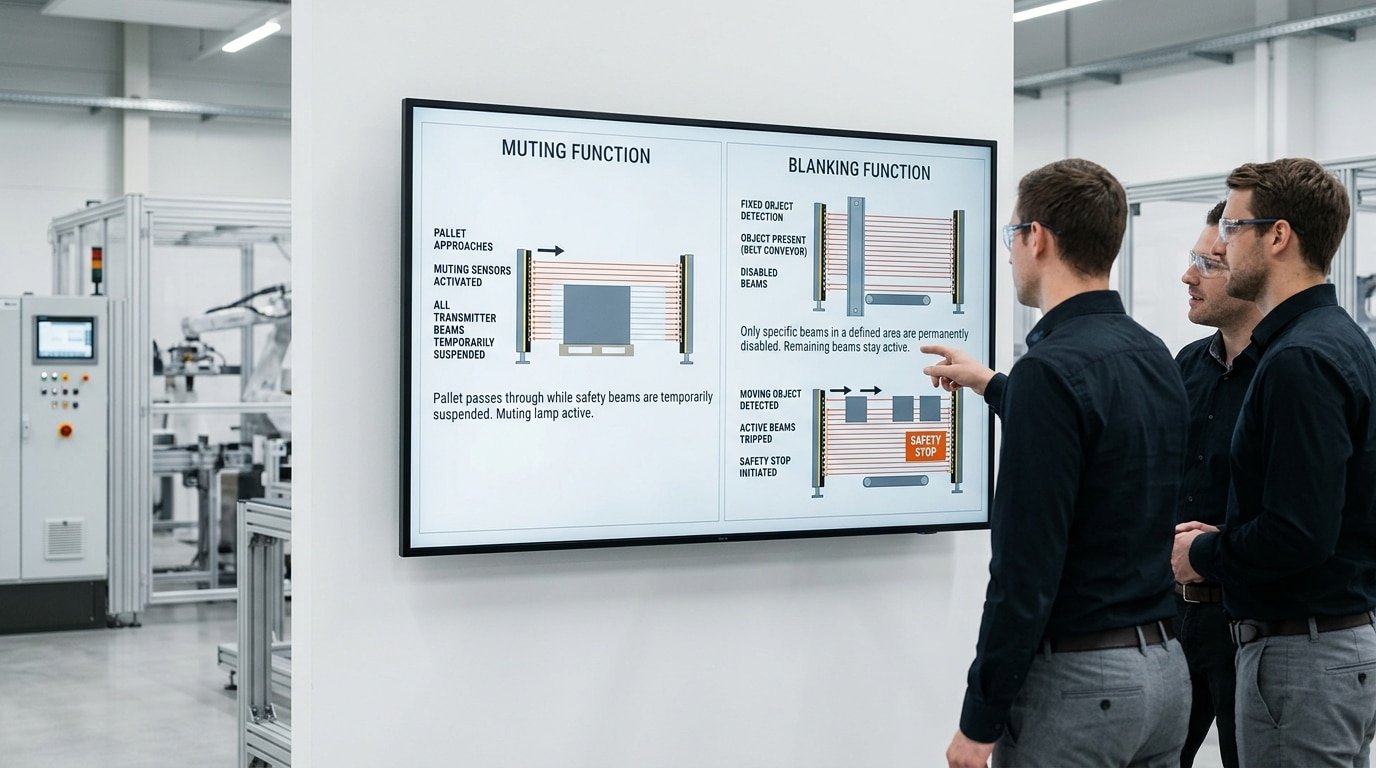
The main thing separating a muting vs blanking light curtain setup comes down to scope and timing. Muting basically pauses the whole protective field for a moment so an expected object can pass all the way through, and then it switches back on. Blanking, though, permanently turns off only certain beams so a fixed or slow-moving object can sit in part of the field while everything else keeps watching over people. You would use muting when material needs to pass through, and you would use blanking when a machine frame or a conveyor always sits in the way of certain beams.
Muting gets described by industry sources as the “temporary automatic suspension of a safety function during the non-hazardous portion of the process cycle.” Essentially, all the beams get ignored for a short window so a pallet can move in without the machine stopping. Extra sensors and some logic actually decide whether the thing entering is a box or a person.
Blanking does its job in a different way. It only bypasses a section of the sensing field. The beams that get turned off stay off, but every other beam keeps looking for anything breaking through. That difference really matters. Muting is based on time and covers everything, while blanking is based on specific beams and stays that way constantly.
When does each one apply?
Go with muting when parts have to cross the curtain now and then, like when pallets feed into a palletizer. Go with blanking when a known object stays put in the field the whole time. A 2023 white paper points out that using blanking to ignore the beams a conveyor is blocking is often cheaper than mounting two separate light curtains to guard both above and below. Considering both options, here is one warning that applies to each. Never leave a reachable gap that is wide enough for a hand or an arm to slip through without being noticed.
How does a safety light curtain protect operators in the first place?
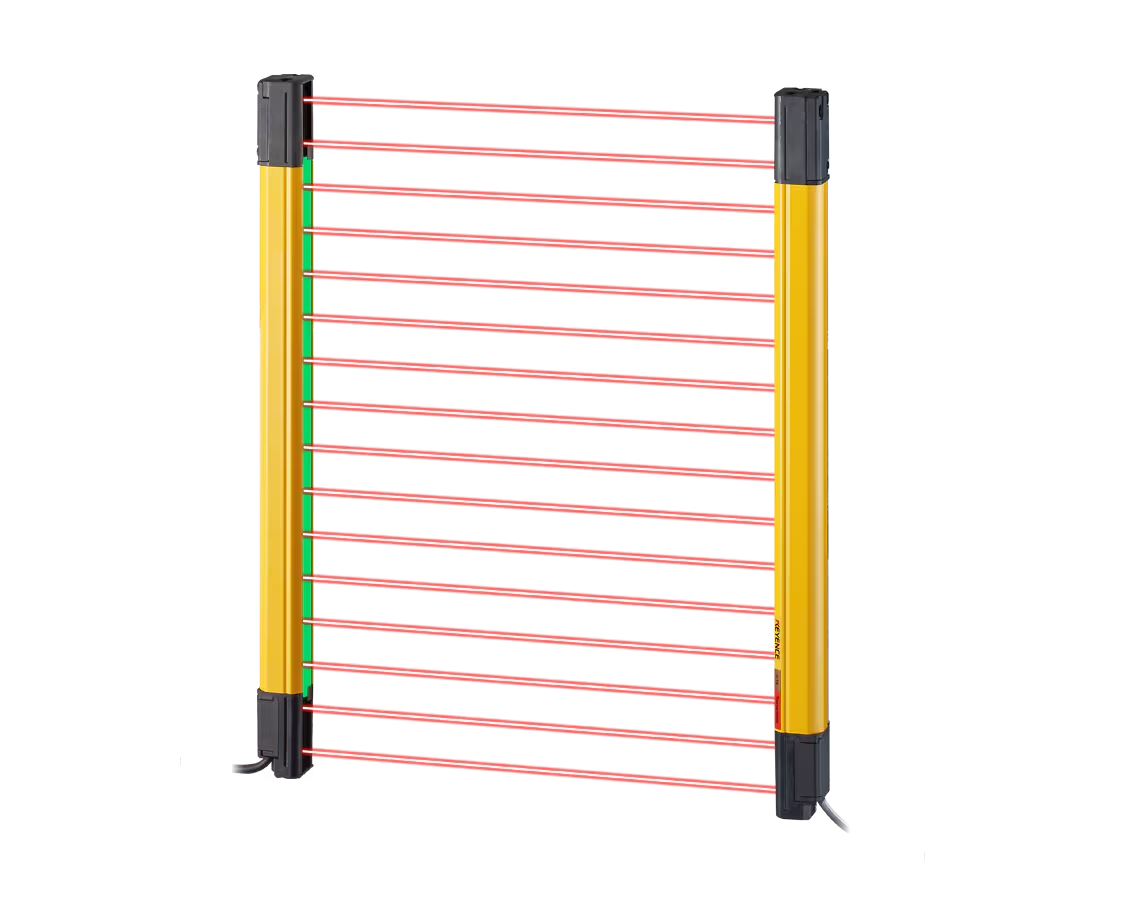
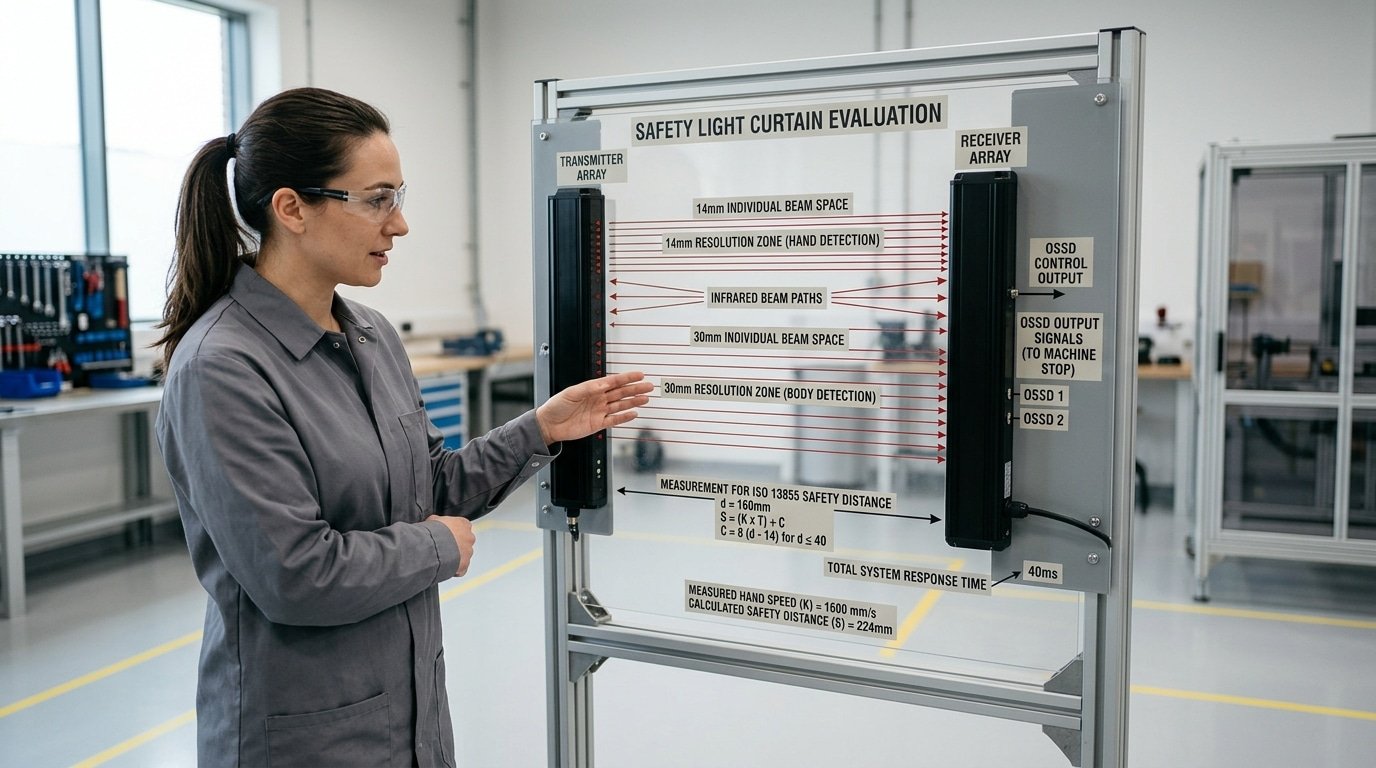
A safety light curtain protects operators by sending an invisible grid of infrared beams between a transmitter and receiver. When a hand, arm, or body breaks a beam, the receiver instantly cuts power to the hazardous motion. This is the baseline you must grasp before comparing a muting vs blanking light curtain setup, because both functions modify this exact detection behavior.
How do resolution and beam arrays decide what gets detected?
Resolution sets the smallest object the curtain can catch. A 14mm[3] resolution detects a finger; 30mm detects a hand. The transmitter fires synchronized infrared pulses, and the receiver checks each beam in sequence. Miss one beam, and the system treats it as an intrusion.
- Transmitter array: emits timed infrared beams, spaced by resolution (14mm[4], 30mm, or 40mm[5] gaps).
- Receiver array: reads each beam and drives the OSSD outputs (Output Signal Switching Devices — two safety-rated signals that go LOW to stop the machine).
How do response time and distance shape safe placement?
The stop signal is only useful if the curtain sits far enough from the danger. ISO 13855 calculates minimum safety distance using a 2000 mm/s hand approach speed plus the curtain’s response time (often 10,30 ms[6]) and the machine’s own stopping time. A slower response forces the curtain further back. Muting and blanking never change this formula, they only decide which beams stay active during a cycle.
What’s muting and when is it used on conveyors and palletizers?
Muting means temporarily and automatically switching off a safety light curtain’s stop function so that an expected object can pass through without stopping the machine. In simple terms, the curtain normally halts the equipment the moment its light beams are broken, but muting lets you pause that reaction on purpose. SICK defines muting (2023) as suspending the safety function only during the part of the cycle that carries no danger. This is different from the muting vs blanking light curtain distinction, where blanking simply ignores certain fixed beams. Muting instead ignores the entire curtain for a controlled window of time and then turns the protection back on.
The whole point is being able to tell the difference between a product and a person. Muting sensors, which are usually photoelectric or laser based, detect both that an object is present and the order in which it arrives. Two conditions have to be true before the curtain is muted, and both of those trigger points must clear in the correct sequence.
How do 2-sensor and 4-sensor arrangements differ?
A 2-sensor setup uses two beams crossed into an “X” pattern near the opening. Both beams need to be broken within a short timing window, often around 3 seconds, before muting begins. If a person walks through instead, they only break one beam, or they break the beams out of order, so muting never starts and the machine stays protected.
A 4-sensor arrangement adds a second pair of beams to cover longer objects or flow that moves in both directions, which gives you tighter protection against someone trying to defeat the system on pallet infeed and outfeed lines. This is the standard approach on palletizers, where muting handles pallet transfer (2022) at a point where no dangerous motion can actually be reached.
- Muting lamp: A visible indicator light required by IEC/TS 62046 that shows when the safety function is as of 2026 suspended.
- Muting timeout: A maximum time limit that ends muting if the object gets stuck or stalls inside the field.
- Sequence logic: The sensors have to activate in a set order, which blocks anyone from deliberately tricking the system.

What’s blanking and how do fixed and floating blanking differ?
Blanking turns off certain individual beams in a safety light curtain while everything else keeps working normally. According to SICK’s 2023 definition, it means “bypassing a portion of the sensing field” so that a known object can rest inside the curtain without shutting the machine down. Unlike a muting vs blanking light curtain comparison done at the process level, blanking is really a permanent zone setting that stays in place.
What’s fixed blanking?
Fixed blanking tells the curtain to ignore a preset group of beams that a stationary object always sits in front of. Picture a conveyor rail or a machine frame that permanently blocks, say, beams 8 through 12. Those beams are basically instructed to expect an object there at all times. And if the fixture ever moves out of position, the curtain trips, which acts as a built-in check against defeating the system.
What’s floating blanking?
Floating blanking tolerates a moving object across a set number of beams. A hydraulic hose that wiggles or a part that sways around can drift a bit, so the controller allows one or two beams to be broken anywhere along the length of the curtain. The blocked beam isn’t tied to any single location, it essentially floats along with the object as it moves.
How does blanking change detection capability?
Both types reduce the effective resolution of the curtain. If a 14 mm curtain floats one beam, an operator’s finger could slip into the gap without being detected, so the resolution effectively drops toward 30 mm[7] or more. The IEC 61496-2 and ISO 13849-1 standards require you to confirm that no reachable dangerous opening has been created. A practical tip worth keeping in mind: always recalculate the minimum object detection size after you enable floating blanking, and never simply trust what the label says.

How do muting and blanking compare on risk reduction, resolution, and standards?
Muting keeps full resolution but relies on external sensor logic; fixed blanking permanently voids beams and coarsens detection; floating blanking degrades resolution by roughly one object diameter per beam allowed to move. In a muting vs blanking light curtain choice, blanking almost always forces a recalculated safety distance, while muting keeps the original resolution but adds sensor-logic failure risk.
⚠️ Common mistake: Blanking a beam on a 14mm fine-finger curtain, then assuming it still protects fingers. This happens because blanking permanently disables those beams, degrading detection capability from 14mm to a coarser resolution that misses fingers. The fix: reserve blanking for larger-object curtains, or use floating blanking with a validated resolution check per IEC 61496 and ISO 13849-1.
When you disable beams, your effective resolution (the smallest object the curtain can spot) gets worse. A 14 mm[8] finger-detection curtain that blanks two beams may drop to 30 mm hand detection. That widens the minimum safety distance under the reach-through formula in ISO 13855.
| Function | Resolution impact | Distance recalc | PL/SIL implication | Typical failure |
|---|---|---|---|---|
| Muting | None — full grid preserved | Not needed for the curtain | Muting sensors must match curtain PL (up to PLe/SIL3) | Defeat by fake muting signal |
| Fixed blanking | Coarser at voided beams | Required | Reduced coverage per IEC 61496-1 | Reachable gap if object removed |
| Floating blanking | Drops ~1 beam pitch | Required | Must stay within ISO 13849-1 PL target | Object drift into gap |
Both functions can hold PLe/SIL 3, the top rating, but only if the added logic (muting sensors or blanking configuration) is validated to the same level. The design rules sit in IEC 61496-1 for the device and IEC/TS 62046 for muting layout. Skip that validation and you inherit the weakest link’s failure rate.
What are the real-world failure modes and defeat scenarios for each function?
Muting fails mostly through defeat: workers bypass sensors or set the muting time limit too long, leaving the light curtain switched off while someone walks through. Blanking fails differently, an oversized blanked zone becomes a permanent blind spot a hand or arm can reach through. In a muting vs blanking light curtain risk review, muting defeat is the more common source of citations.
How does muting get defeated on a real machine?
Operators jam or tape muting sensors so the curtain stays muted continuously, turning a timed suspension into a full shutoff. Another failure is setting the muting timer to hours instead of the few seconds a pallet needs to clear. Unmonitored muting, no muting lamp, no independent sensor cross-checking, is a frequent finding under OSHA 1910.212 machine guarding, because there’s no proof the curtain reactivated.
How does blanking create a reachable gap?
Blanking removes beams, so every disabled beam is a hole. If the blanked area exceeds the object it was meant to cover, the extra space lets a person reach past. A blanked band 200 mm[9] wide easily admits a hand. Floating blanking is worse when the tolerance is set loose, since the ignored beam can drift across the field. Always measure the blanked width against reach distances in ISO 13857 before trusting the setup.
How do you wire, position sensors, and configure muting and blanking safely?
Wire muting sensors in crossed pairs and configure blanking by teaching the exact beams a fixture occupies. Muting uses at least two independent sensors whose signals must overlap within a set time window; blanking flips beam logic so selected beams must always sense an object. Get the geometry wrong and protection drops silently, with no fault flagged.
How do you position and time muting sensors correctly?
Place two muting sensors so their beams cross at a point inside the light curtain plane, not on top of it. Crossed beams confirm both direction and object length; parallel beams are easier to defeat by hand. Standard practice ties the muting window to conveyor speed,a common rule is a time limit of 10 seconds, after which the safety function re-arms automatically. IEC/TS 62046 is the design reference for these sensor arrangements, as noted in a 2023 machine safety article. Wire a muting lamp (often 3,7 W) that must be visible; if it burns out, most safety relays inhibit muting until it’s replaced.
How do you teach blanking zones without leaving a gap?
Teach fixed blanking by placing the fixture in the field and letting the receiver learn which beams stay obstructed. The mistake that quietly cuts protection in a muting vs blanking light curtain setup: blanking a beam wide enough that a hand or arm slips through the gap unseen. Keep any blanked opening below the resolution needed to detect the smallest reachable body part.
Integrate both through a dual-channel safety relay or safety PLC rated to your required performance level. On diagrams, muting inputs are labeled A1/A2 and OSSD pairs carry the stop signal.
How do you choose between muting and blanking for your machine layout?
Choose based on how objects move through the sensing field. If material passes fully through the same opening people use, evaluate muting. If a permanent fixture blocks beams, use fixed blanking. If a small object shifts position within the field, consider floating blanking. Each branch ties to a specific risk-assessment trigger under ISO 13849-1.
Run this decision path against your machine drawing:
- If pallets or cartons must pass through intermittently and no worker can reach hazardous motion during that window → apply muting. The IEC/TS 62046 standard governs sensor placement here. Trigger: your task analysis shows repeated material transit through the guarded opening.
- If a conveyor rail, frame, or tool permanently sits in the beam path → use fixed blanking. One 2023 white paper notes that blanking out conveyor beams beats installing two separate light curtains for above-and-below guarding, per this safety vendor analysis. Trigger: a static obstruction would cause nuisance trips.
- If a part vibrates or drifts within a small zone → consider floating blanking. Trigger: the object’s position varies but stays inside a defined band.
Never pick a function to cut wiring cost. The right muting vs blanking light curtain choice starts from your hazard list, not your budget. Document why each ignored beam or muted period can’t create a reachable gap to dangerous motion.
Frequently asked questions about muting and blanking
Quick answers to the questions engineers ask most when weighing a muting vs blanking light curtain decision. Muting doesn’t lower the certified safety rating, floating blanking is legal only under specific conditions, and yes, both functions can run on one curtain.
Does muting reduce the safety rating of the curtain?
No. Muting keeps the curtain’s certified performance level intact because the device itself still meets its ISO 13849-1 PL and IEC 61496 category. The risk shifts to the muting logic, not the sensor. A correctly designed muting circuit uses two or four sensors so a single failure can’t suspend protection. Poor logic, not the muting function, is what actually erodes safety.
Is floating blanking legal for hand detection?
It depends on the resolution left after blanking. Floating blanking widens the smallest detectable object. If disabling one or two beams pushes detection above 40 mm[10], hand detection is no longer reliable, and finger detection needs 14 mm resolution. Per OSHA 1910.212, the safeguard must still prevent the operator from reaching the hazard.
How many muting sensors are required?
Most conveyor applications use a minimum of two sensors in a crossed configuration, and many high-risk lines use four. IEC/TS 62046 recommends geometry that makes a person unable to trigger the mute sequence alone. Two sensors verify object direction; four add object-length checking so a slow-walking worker can’t fool the timer.
Can one curtain use both functions?
Yes. A single curtain can run fixed blanking for a conveyor frame while muting handles full pallet passage, as long as each zone is validated separately.
Choosing the right function and staying compliant
Pick muting when whole loads must pass fully through the curtain, and pick blanking when a fixed object permanently sits inside the field. A 2023 safety light curtain white paper notes that blanking beams occupied by a conveyor can replace two separate curtains, while muting suits objects that cross intermittently. Both functions must survive a documented risk assessment before you touch any setting.
The decision tree is short. Does material move through the sensing field on a schedule your logic can predict? Muting. Does a tool, fixture, or frame always block the same beams? Blanking. Neither answer replaces the risk assessment, it only tells you which function to assess.
Here is the trap many teams fall into: they configure the muting vs blanking light curtain function first, then write the paperwork to match. Reverse that order. Start with the hazard analysis, calculate your required Performance Level under ISO 13849-1, then verify the device meets the Type and detection specs in IEC 61496-1/2. Muting design also references IEC/TS 62046 for sensor arrangement.
Your next step is concrete. Pull your machine’s current risk assessment. Confirm it names the exact function you plan to enable and the residual risk it leaves. If that document doesn’t exist or predates your last layout change, stop configuring and re-run the assessment. A blanking gap or a defeated muting sensor is a citation waiting to happen, and worse, an injury.
See also
What Is a Safety Light Curtain and How It Protects Workers
IP67 vs IP68 sensors compared with depth and time limits
Waterproof Light Curtain Selection for Wet Industrial Areas
Optical Synchronous Light Curtains