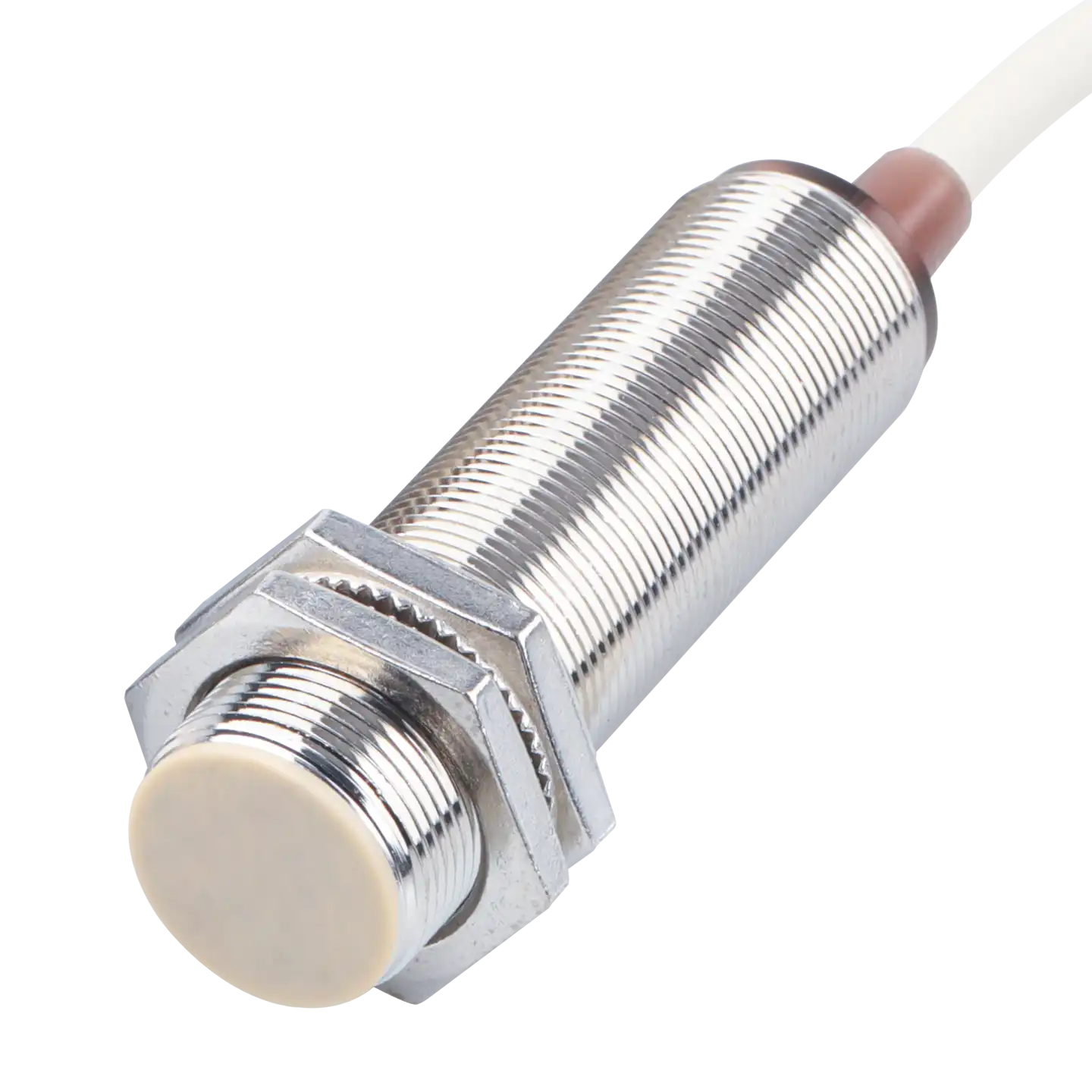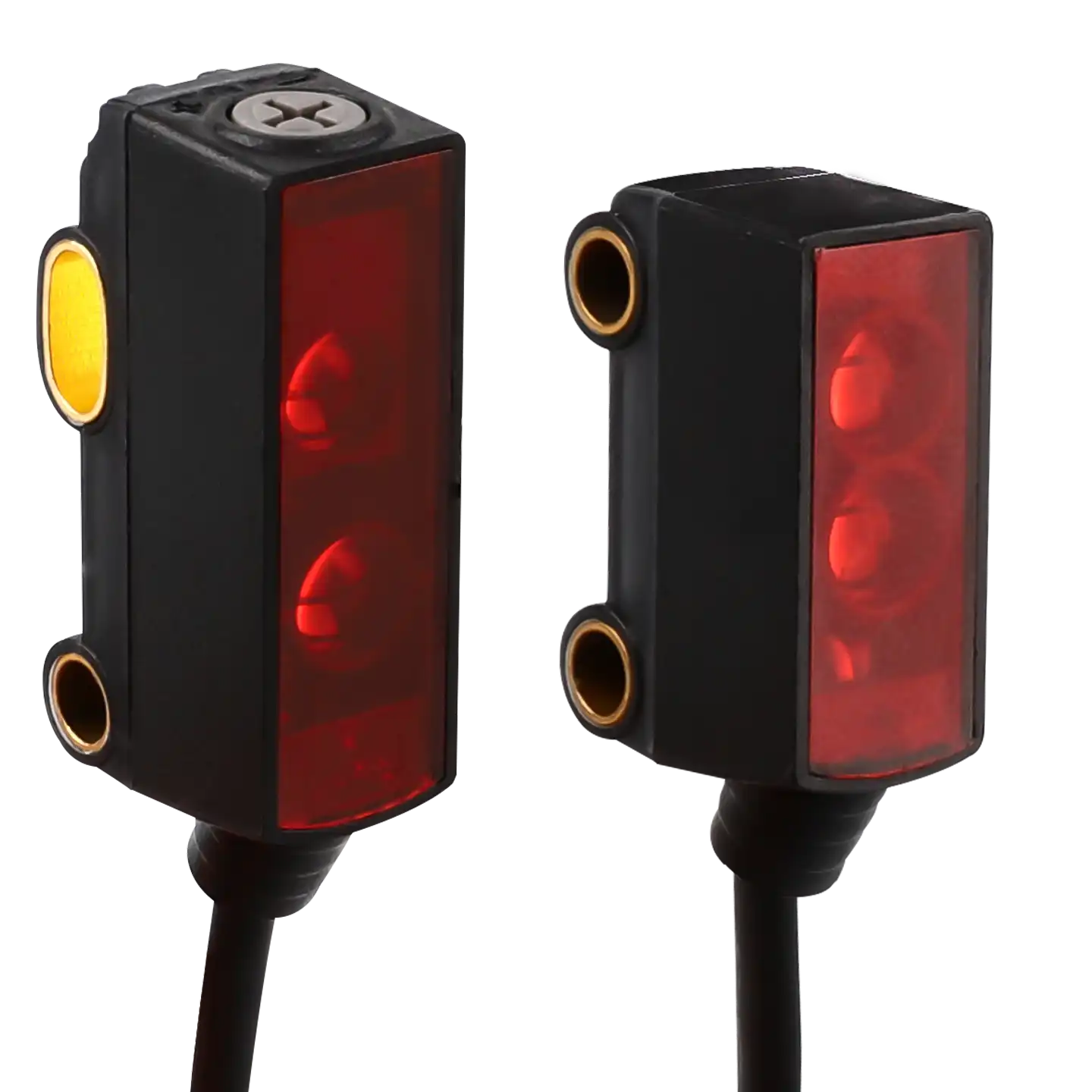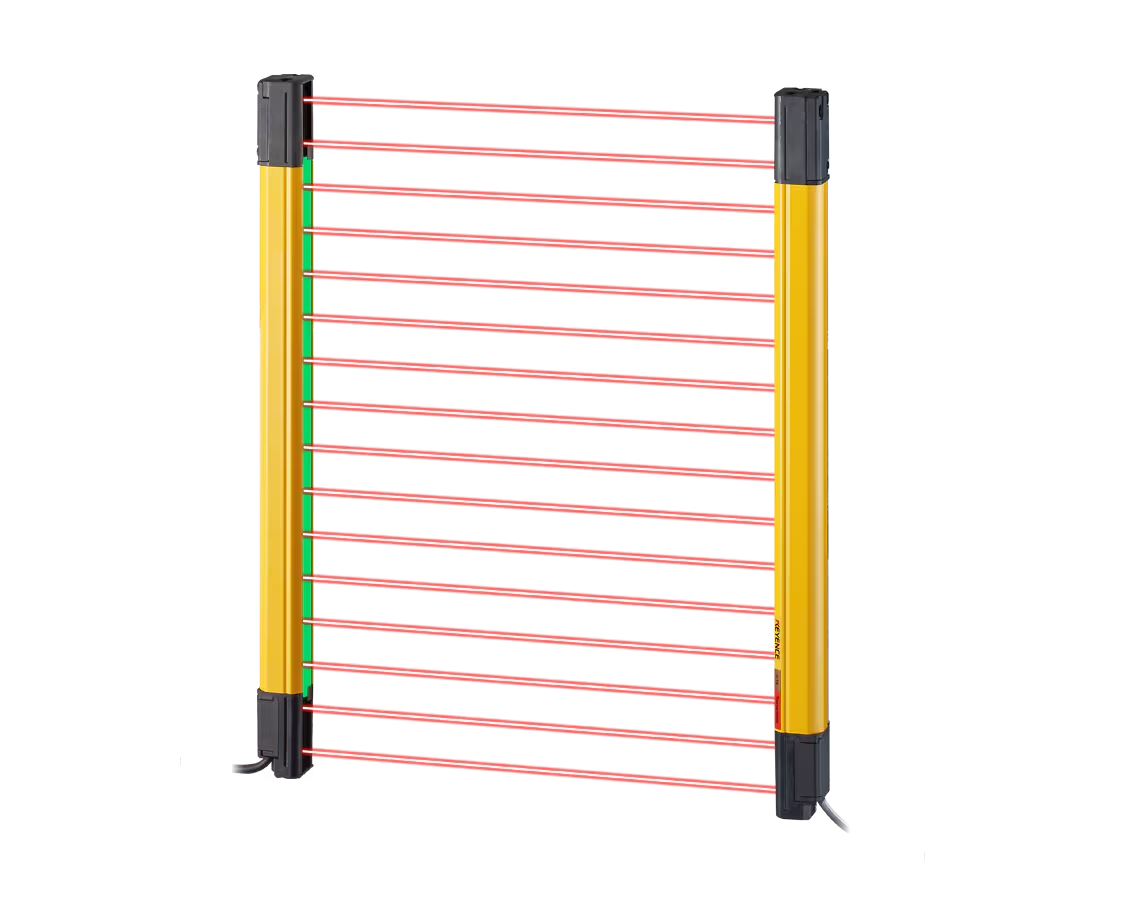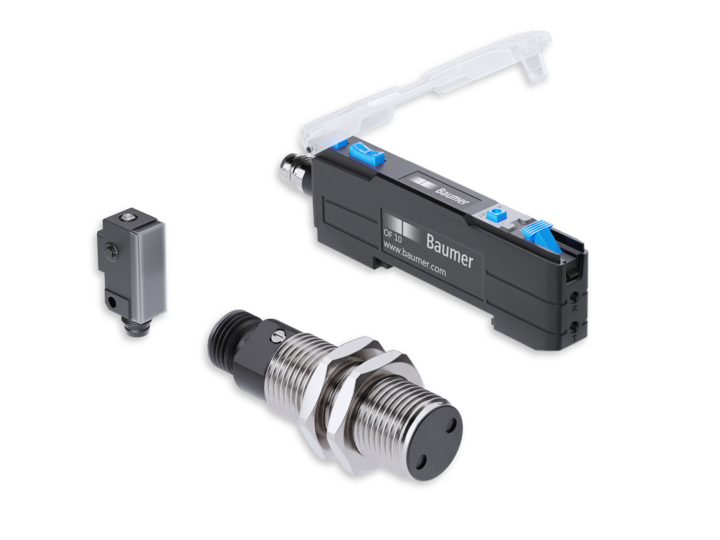
A proximity sensor is a non-contact device that detects nearby objects without physical touch, typically by emitting an electromagnetic field or beam and monitoring changes in the return signal. When something enters range, it flips an electrical signal with no moving parts to wear down, enabling lifespans past 10 million cycles. Standard sensing ranges span 1mm[1] to 60mm, while photoelectric types reach several meters. It’s the quiet workhorse behind smartphone screens that dim during calls and robot arms that halt before a collision.
This guide sets out to answer the questions people actually ask. What is a proximity sensor doing at the physics level, and how does it really work? What types exist, meaning inductive, capacitive, photoelectric, and ultrasonic, and how do they differ from one another? What parts are sitting inside one of these devices? Which specifications, things like sensing range, output type, and response time, genuinely matter when you go to choose one? And where do these sensors actually show up in real machines, phones, and cars?
Quick Takeaways
- Non-contact detection eliminates mechanical wear, delivering lifespans exceeding 10 million cycles.
- Choose inductive sensors for metal; capacitive detects plastic, liquid, and wood.
- Match sensing range to your task, typically 1mm to 60mm[2].
- Pick photoelectric sensors when detection distances span several meters using light beams.
- Prioritize response times near 0.1ms for high-speed production line tracking.
What’s a proximity sensor and how does it detect without touching?
A proximity sensor is a non-contact device that detects whether something is present, absent, or sitting at a certain distance inside a set range. It works by putting out an electromagnetic field or a beam and then watching for changes in the signal that comes back, so it can spot an object before anything actually touches it. The heart of the sensor is its sensing field, and you can picture it as an invisible bubble sitting right in front of the sensor face. When a target moves into that bubble, the sensor’s internal circuit changes state and flips its switching output, which is basically a simple on/off electrical signal the machine can read.
There are no moving parts, no pressure, and no wear.
Compare this to a mechanical limit switch, which needs a physical lever or plunger to actually get pushed by the target. Every single push wears the contacts down a little, and over thousands of cycles the springs fatigue and the contacts start to pit. Non-contact detection removes that failure mode completely, which is really why proximity sensors get chosen over limit switches, since the design eliminates mechanical wear and raises service life. A single inductive sensor can survive tens of millions of switching cycles simply because nothing ever touches it.
Here is one practical tip worth keeping in mind. The “set range” is the rated sensing distance, but the range you can actually use shrinks depending on the size and material of the target. You always want to leave a safety margin, and engineers typically design at 70-80%[3] of the rated distance to avoid dropout caused by temperature drift or misalignment.

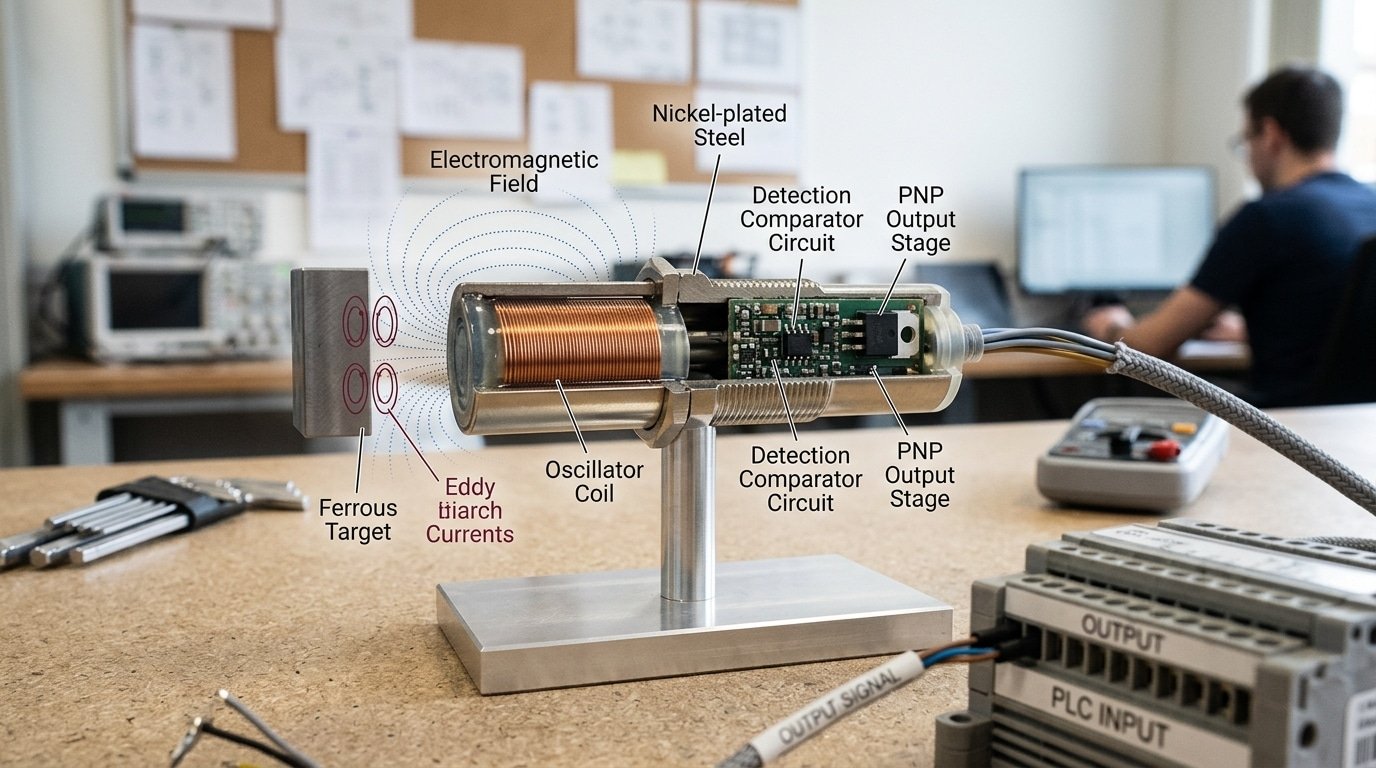
Every proximity sensor runs the same three-step loop: it sends out an energy field, watches how a target changes that field, then flips a signal on or off. The energy can be an electromagnetic field or beam, and the sensor monitors the return signal for any shift caused by a nearby object.
Here is the full cycle broken down:
- Emit: An oscillator generates the active field. In an inductive type, a coil creates a high-frequency electromagnetic field (usually 100–1000 kHz) at the sensing face.
- Disturb: A target enters the field. A metal object pulls energy from an inductive field through eddy currents (tiny circular currents induced in the metal), which drains the oscillator’s amplitude.
- Detect: The detection circuit compares the changed signal against a fixed threshold. Cross that threshold, and it trips.
- Output: The output stage delivers the result — a digital on/off switch (PNP or NPN) or an analog voltage that scales with distance.
What does each internal stage actually do?
The oscillator is the heart. It burns steady power to keep the field alive, which is why an inductive sensor still draws a small idle current, often 10,15 mA, even when nothing is near. The detection circuit acts as a comparator: it ignores noise and only reacts when the signal shift crosses the threshold. The output stage protects the load and sets the electrical logic your PLC reads. Because this loop is non-contact, there are no moving parts to wear out, the reason factories swap mechanical limit switches for proximity types, since the non-contact design eliminates mechanical wear and stretches service life well past millions of cycles.
What are the main types of proximity sensors and what does each detect?
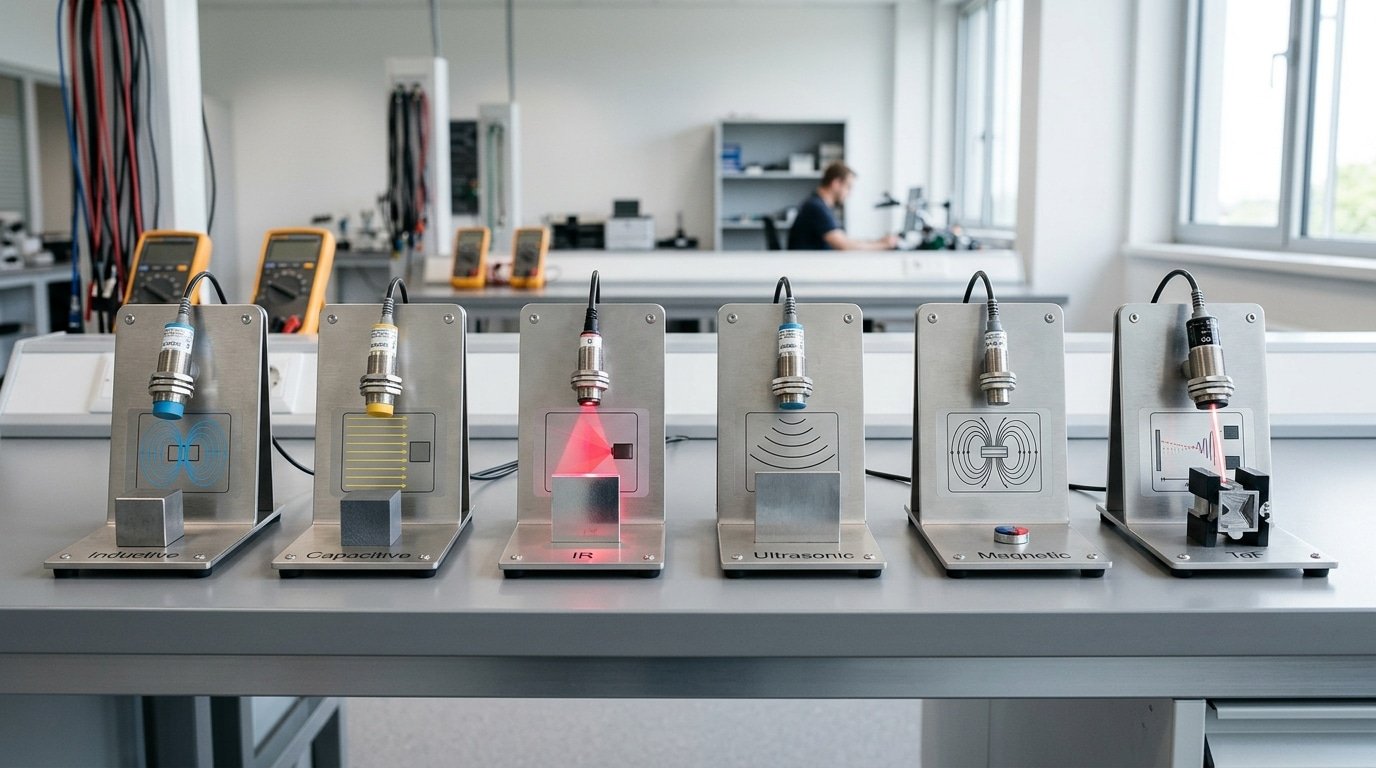
There are six main proximity sensor types, and they are inductive, capacitive, infrared (IR), ultrasonic, magnetic, and time-of-flight (ToF). Each one responds to a different physical property, meaning they notice completely different things about whatever is in front of them. Industry documentation tends to group the common industrial ones as inductive, capacitive, ultrasonic, photoelectric, and magnetic. If you choose the wrong type for your job, the sensor will either fail to notice the target at all or keep triggering when nothing is really there.
So why does an inductive sensor only see metal? It creates eddy currents, which are tiny swirling electric currents, inside conductive objects by using an electromagnetic field. Materials like plastic, glass, and liquids never produce eddy currents, so an inductive head basically ignores them. That is exactly why this type dominates factory floors when the task is counting metal parts.
- Inductive: detects only metal by way of eddy currents, works over a range of 2–40 mm, and is not bothered by dust or oil.
- Capacitive: senses almost any material, including water, grain, plastic, and powder, by measuring the change in capacitance right at the active face. It works well for checking the level of something through the wall of a tank.
- Infrared (IR): uses an IR LED along with a detector to read light that bounces back. This is the same pair inside your phone that blanks the screen when you hold it near your ear.
- Ultrasonic: sends out sound waves and times how long the echo takes to return, so it works on clear glass, shiny metal, or black rubber. Color and transparency do not fool it.
- Magnetic: triggers when it senses a magnetic field, and it can read through non-magnetic walls such as aluminum housings.
- Time-of-flight (ToF): times how long a laser pulse takes to travel out and come back, then reports the actual distance in millimeters instead of only saying present or absent.
Here is the practical divide that matters most. Inductive, capacitive, and magnetic types give you a simple on or off answer, while ultrasonic and ToF hand back a measured distance instead. That one split settles about half of your selection work, and it is covered next.
Which proximity sensor should you choose for a given target material and distance?
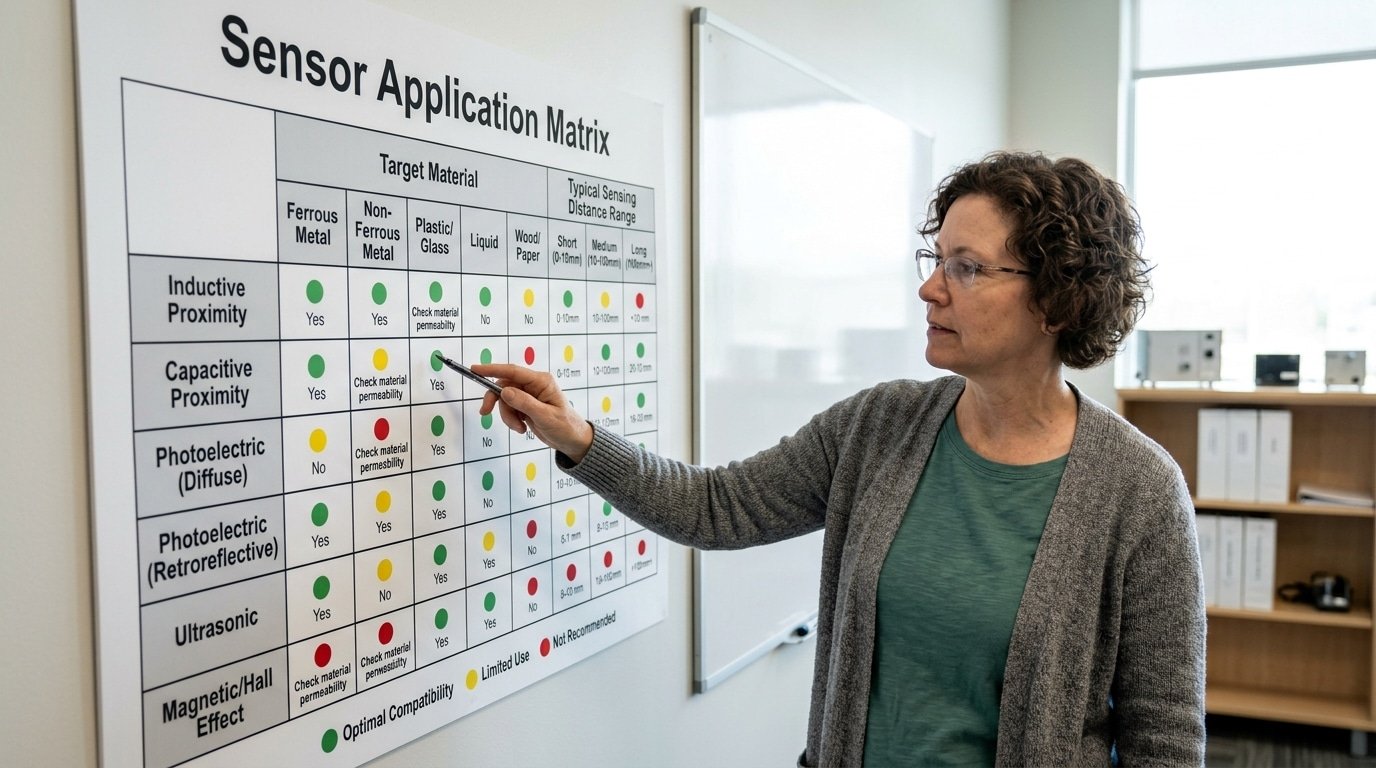
The smart approach is to match the sensor to the target first, and then worry about the range. If you’re detecting metal at close range, you’ll want to use an inductive sensor. Detecting a plastic bottle, glass, or a liquid level instead? Then capacitive is the way to go. And if you need to spot a human hand or an object several meters away, ultrasonic or photoelectric sensors are your options. Since inductive sensors rely on eddy currents in metal, they simply ignore plastic and glass entirely, so the material really decides your options before the distance ever comes into play.
⚠️ Common mistake: Using an inductive proximity sensor to detect plastic, liquid, or wood targets, then wondering why nothing registers. This happens because inductive sensors rely on eddy currents induced in metal—non-metallic objects never disturb the electromagnetic field. The fix: switch to a capacitive sensor, which detects non-metals within the same 1mm[4]–60mm range.
There’s a common trap worth knowing about here. Capacitive sensors detect almost anything, but they also trigger on dust, moisture, and buildup. That kind of flexibility costs you in terms of noise immunity, meaning the sensor picks up things you don’t want it to. Generally, it’s best to skip capacitive in dirty environments unless you take the time to tune the sensitivity carefully.
How do range and material line up across the six technologies?
The table below maps each type to its practical sensing range and the targets it can handle. These are typical industrial values, though you should always check the datasheet for your exact part before committing.
| Sensor type | Typical range | Best targets | Environmental limit |
|---|---|---|---|
| Inductive | 1–60 mm | Metal only | Ignores dust; short reach |
| Capacitive | 1–40 mm | Plastic, glass, liquid, metal | False trips from moisture |
| Infrared (IR) | 2–100 mm[5] | Hand, most solids | Fooled by dark or shiny surfaces |
| Photoelectric | Up to 10 m | Most opaque objects | Struggles with clear glass |
| Ultrasonic | 20 mm–8 m | Any solid, liquid, glass | Soft foam absorbs echoes |
| Magnetic | 10–70 mm | Magnets only | Needs a magnet on target |
There’s one practical rule that experienced people tend to follow. For clear glass or a shiny liquid, you should pick ultrasonic over photoelectric, because sound waves simply don’t care about transparency the way that light beams do. Understanding what is a proximity sensor detecting at the physics level really saves you from choosing a type that will never actually see your target.
What specs and wiring matter — sensing range, response time, and NPN vs PNP?
The specs engineers check first are effective sensing range, response time, and output wiring type. Nominal range (Sn) is the ideal figure on the datasheet; effective range runs about 10%[6] less because of temperature and voltage drift. Get these three right and your sensor triggers cleanly. Get them wrong and your automation line misses parts.
Which performance numbers actually decide reliability?
Four figures separate a good pick from a failing one:
- Nominal vs effective range (Sn / Sr): Sr is derated for tolerances, often to approximately 90% of Sn. A 4mm Sn inductive sensor may only guarantee 3.24mm[7] reliably.
- Hysteresis: the gap between switch-on and switch-off points, usually 3-15% of range. It stops chattering when a target hovers at the edge.
- Response time: how fast the output flips, from under 0.5ms on high-speed inductive types to 20ms+ on ultrasonic. Fast conveyors counting 3,000 parts per minute need sub-millisecond timing.
- Repeatability: how consistently the trip point repeats, often within approximately 5% of Sr. Poor repeatability ruins precision positioning.
NPN or PNP — which output do you wire?
Match the output to your controller’s input, not the other way around. PNP (sourcing) sends positive voltage to the input and dominates in European and North American PLCs. NPN (sinking) pulls the input to ground and is common in Asian designs and many microcontrollers.
| Wiring | Wires | Best for |
|---|---|---|
| 2-wire | Power + signal shared | Simple relay loads, some leakage current |
| 3-wire NPN | +V, 0V[8], signal to ground | Sinking PLC inputs, Arduino |
| 3-wire PNP | +V, 0V, signal to +V | Sourcing PLC inputs (most common) |
| 4-wire | Both NO + NC outputs | Flexible logic, dual signaling |
Also pick NO (normally open) or NC (normally closed). NC is safer for safety interlocks, a cut wire reads as “danger” and stops the machine. That fail-safe logic is why understanding what’s a proximity sensor’s output configuration matters as much as its range.
Where are proximity sensors used in phones, robotics, and factory automation?
Proximity sensors run quietly inside three worlds: consumer electronics, robotics, and factory lines. In a phone, an infrared LED and IR detector turn off the screen when you hold it to your ear, a standard smartphone design that stops your cheek from tapping buttons and saves battery during calls. Each setting picks a sensor type that matches its target and distance.
How do phones and mobile devices use them?
Phones lean on two proximity technologies. The IR call sensor fits because skin reflects infrared well at 1,5 cm, exactly the ear-to-screen gap. Time-of-flight (ToF) sensors handle camera autofocus by timing a laser pulse’s round trip, locking focus in under 30 milliseconds even in low light where contrast-based focus fails.
Where do they fit in factory automation?
On conveyors, inductive sensors count metal parts as each one passes the active face. Inductive fits here because it only reacts to metal, so plastic trays or dust never cause a false count. Magnetic sensors mounted on pneumatic cylinders confirm end-of-stroke position, they detect the piston’s built-in magnet through the aluminum wall, something inductive types can’t do reliably. This non-contact operation removes mechanical wear, which is why these sensors outlast limit switches by a wide margin in high-cycle lines running millions of actuations per year.
What do robots and AGVs rely on?
Automated guided vehicles (AGVs) use ultrasonic sensors to detect wooden pallets and cardboard boxes. Ultrasonic wins here because sound bounces off almost any surface, color, gloss, and material don’t matter, so it spots a pallet an IR beam might miss. That reliability is core to collision avoidance and safe robot navigation.
Why do proximity sensors give false triggers or dead zones, and how do you fix them?
Most proximity sensor faults trace back to four causes: electrical noise, mutual interference between nearby sensors, near-field dead zones, and contamination on the sensing face. A proximity sensor is a non-contact device, so its reliability comes largely from correct mounting and spacing, industry data shows non-contact designs outlast mechanical limit switches by eliminating wear, but only when installed right.
What causes false triggers, and how do you stop them?
False triggers usually come from electrical noise or two sensors “talking” to each other. Mount inductive sensors too close together and their electromagnetic fields overlap, causing phantom detections. The fix is spacing rules: keep the gap between two flush-mount inductive sensors at least twice the sensor diameter, and non-flush units at least three times. For electrical noise, route sensor cables away from motor drives and use shielded cable grounded at one end only.
Why do sensors have dead zones, and can you avoid them?
Ultrasonic sensors have a blind zone right in front of the face, often the first 3 to 20 cm[9], because the transducer is still “ringing” from its own pulse and can’t hear the echo. Never place a target inside this near-field window. Choose a model whose minimum range sits below your closest target distance.
How do you handle weak range and dirty faces?
- Non-ferrous derating: Inductive sensors lose range on aluminum, brass, and copper. Aluminum can cut rated range by roughly 60%. Apply the reduction factor from the datasheet before you set spacing.
- Contamination: Capacitive sensors detect dirt, oil, and condensation as false targets. Wipe the face, add a shroud, or lower sensitivity so a water film doesn’t switch the output.
Frequently asked questions about proximity sensors
The short answers: most proximity sensors don’t reliably detect humans (only IR and capacitive types do), sensing range runs from 1mm to 10 meters depending on type, and no common sensor sees through solid walls. A proximity sensor reads changes in a field or beam, so metal, water, and thick concrete each block or distort it differently.
Do proximity sensors detect humans?
Only some do. Infrared (IR) sensors catch body heat, and capacitive sensors react to the water in your skin. Inductive sensors ignore people entirely, since they only respond to metal via eddy currents. This is why a metal-detecting factory sensor never trips when a worker walks past.
How far can a proximity sensor sense, and does it work through walls or water?
Range depends on type. Inductive units cover 1,60mm. Ultrasonic and photoelectric models reach up to 10 meters. Solid walls block IR and inductive fields completely. Capacitive sensors can read liquid through thin plastic tank walls, which is exactly how they gauge fluid levels.
What’s the difference between a proximity sensor and a motion sensor?
A proximity sensor reports whether an object is present at a fixed distance. A motion sensor only fires when something moves. What is a proximity sensor good for that motion sensing isn’t? Counting stationary parts and confirming a machine part reached its stop position.
What do proximity sensors cost and how long do they last?
Industrial inductive sensors sell for approximately $10[10] to approximately $60. Because non-contact operation removes mechanical wear, service life beats mechanical limit switches by a wide margin, often running for tens of millions of switching cycles.
Choosing and applying the right proximity sensor with confidence
The safe order for picking any proximity sensor is: match target material and range first, verify electrical specs and wiring second, then plan for how it might fail. Getting the sequence right avoids the most expensive mistake, buying a sensor that senses correctly on the bench but dies early in the field. Since non-contact operation eliminates mechanical wear, a well-chosen unit often outlasts a mechanical limit switch by years.
Start with the target. Metal only? An inductive sensor is cheapest and most robust. Mixed materials or liquids?
Capacitive. Long range or transparent objects? Ultrasonic or photoelectric. Lock that choice before touching a datasheet.
Then check the numbers that break installations: effective sensing range at your worst-case gap, response time against your line speed, and NPN vs PNP output matched to your PLC input card. A 100 Hz sensor on a conveyor moving parts every 5 ms will miss counts, do the math, don’t guess.
Plan for failure modes last. Ask what happens on power loss, on electrical noise from a nearby motor drive, and on temperature swings that shift the switching point.
Quick action checklist:
- Confirm target: metal, non-metal, liquid, or transparent — pick the sensor family.
- Derate range: design for 70–80% of rated distance, not the maximum.
- Match output: NPN or PNP to your controller input.
- Shield from noise: separate sensor cables from power lines.
- Field-test the shortlist: mount and run it in the real environment for a full shift before committing.
Never buy on spec sheets alone. Test your top candidate in the actual installation, real vibration, dust, and temperature reveal what lab conditions hide.
Reference Sources
- [1]en.wikipedia.org — supports: A proximity sensor is a non-contact sensor that detects the presence of nearby objects w…
- [2]ifm.com — supports: A proximity sensor is a non-contact sensor that detects the presence of nearby objects w…
- [3]connectorsupplier.com — supports: A proximity sensor is a non-contact sensor that detects the presence of nearby objects w…
- [4]library.automationdirect.com — supports: Industrial proximity sensors are widely used in automation to detect the presence, absen…
- [5]uk.rs-online.com — supports: Industrial proximity sensors are widely used in automation to detect the presence, absen…
- [6]us.misumi-ec.com — supports: Common types of proximity sensors used in industrial applications include inductive, cap…
- [7]sciencedirect.com — supports: Inductive proximity sensors use eddy currents generated in metallic sensing objects by e…
- [8]pcmag.com — supports: Proximity sensors convert detected object presence, absence, or distance into electrical…
- [9]wikipedia.org — supports: General definition, types, and typical operating principles of proximity sensors across …
- [10]automationdirect.com — supports: Industrial automation context, applications, and usage of proximity sensors in machinery.